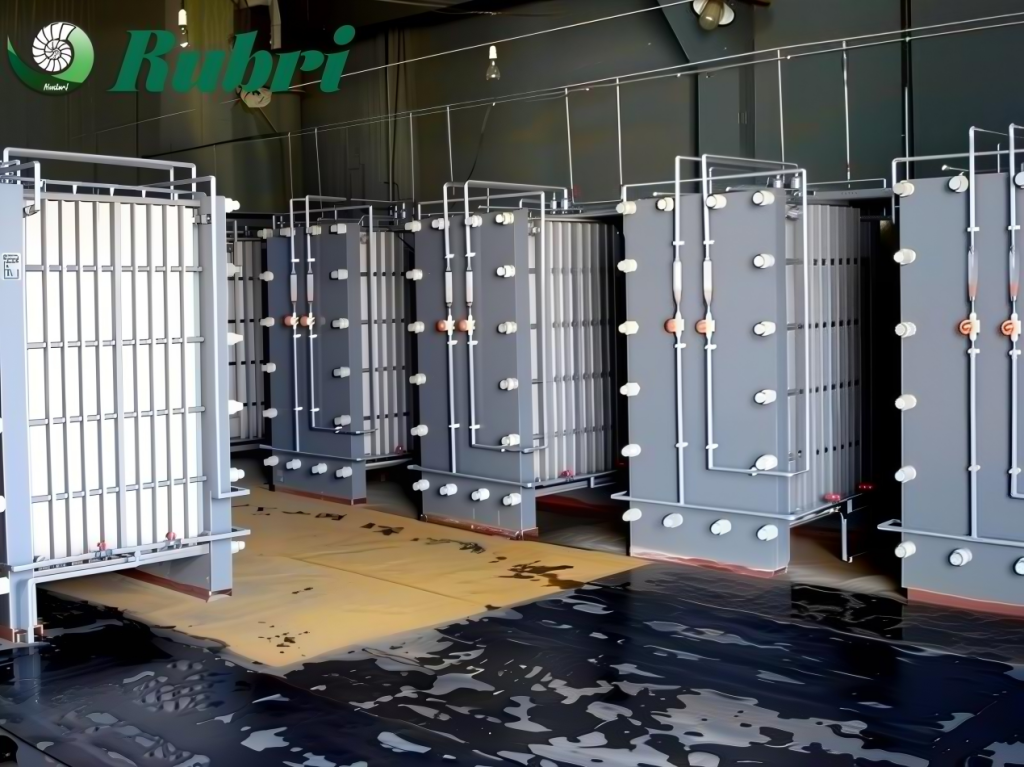
An electrodialysis stack is a device that uses anion- and cation-exchange membranes to selectively transport ions under a DC electric field, enabling solution desalination, concentration, and separation of ionic components.
Structure
- Membrane pair: The basic unit of electrodialysis separation, formed by alternating anion-exchange membranes, diluate chamber spacers, cation-exchange membranes, and concentrate chamber spacers.
- Membrane stack: Assembled by stacking multiple membrane pairs, it is the core part of the equipment for ion separation.
- Auxiliary components: Include electrodes, water distribution plates, clamping plates, and supporting piping, used to provide the electric field, distribute water evenly, and secure the membrane stack structure.
Categories
- Bolt-clamped type: Simple structure and lower cost, suitable for laboratory, pilot-scale, or small and medium-sized water treatment systems.
- Hydraulic integrated type: Uniform clamping pressure and good sealing, suitable for large-scale industrial continuous operation.
Application Scenarios
- Desalination of brackish water, seawater, or low-salinity water.
- Separation and recovery of salts or metal ions from industrial wastewater such as electroplating and printing and dyeing wastewater.
- Desalination, concentration, and refining in food, fermentation, pharmaceutical, and other industries.
- Purification and salt control of electrolyte solutions in new energy-related processes.
Illustrative materials