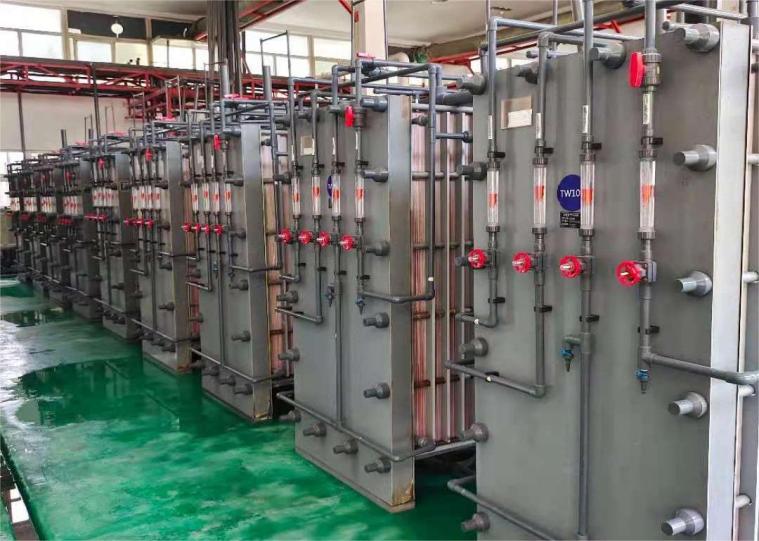
Diffusion dialysis (DD) is used in a 330 m³/day sulfuric acid recovery treatment project for an electronic aluminum foil enterprise to show the treatment scale and operating indicators of this technology route in similar projects.
Key indicators
- Treatment capacity: 330 m³/day
- Number of units: 55
- Membrane area: 2800 m²
- Recovery rate: 82%
- Rejection rate: 95%
Project background
The formation and acid washing steps in electronic aluminum foil production generate large volumes of sulfuric acid-containing waste liquid, which also carries metal impurities such as aluminum ions.
If such waste liquid is directly neutralized, it consumes a large amount of alkali and generates a considerable amount of sludge, while sulfuric acid itself has reuse value.
The project goal is to separate and recover free sulfuric acid from the waste liquid and return it to the production process for recycling, without introducing phase changes or additional chemical reactions.
Process route
- Using a diffusion dialysis anion-exchange membrane as the core, the concentration difference between the waste acid side and the recovery water side serves as the sole driving force.
- Sulfate ions and hydrogen ions in the waste acid preferentially pass through the anion-exchange membrane into the water side to form regenerated acid, while metal impurities such as aluminum ions are retained on the residual liquid side.
- Membrane stacks are arranged in parallel in groups according to treatment scale, with filtration and heat exchange units configured to control influent temperature and particulate levels.
- The entire process operates at ambient temperature and pressure without an external power supply, and the recovered acid is returned directly to the acid washing process.
Operating performance
- Treatment capacity: 330 m³/day.
- Membrane stack equipment configured: 55 units.
- Membrane area: 2800 m².
- Acid recovery rate: 82%.
- Impurity rejection rate: 95%.
Illustrative materials