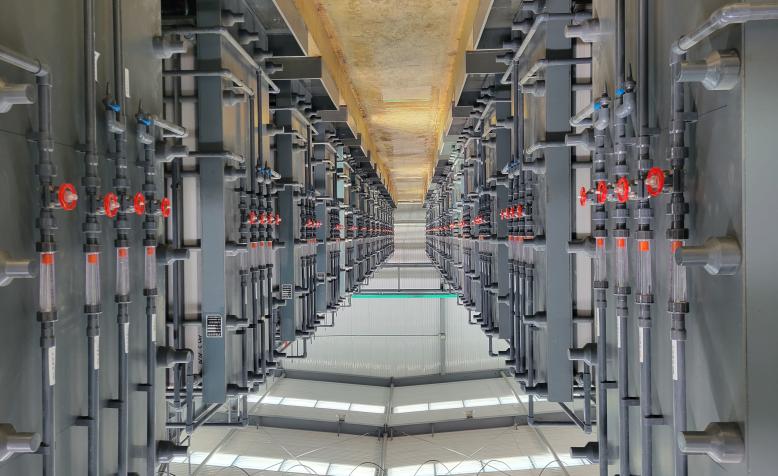
Electrodialysis (ED) for a 4 m3/h high-salinity COD and ammonium sulfate separation project at a pharmaceutical company, used to show the treatment scale and operating indicators of this technical route in similar projects.
Key indicators
- Treatment capacity: 4m3/h
- Salt content is about 45g/L
Project background
Pharmaceutical production wastewater often contains both high-concentration inorganic salts and recalcitrant organic matter, and salts such as ammonium sulfate have recovery value.
If evaporation crystallization is performed directly, organic matter will precipitate together with the salt, resulting in insufficient purity of the salt product and requiring disposal as hazardous waste.
The project objective is to separate salt from organic matter before crystallization so that the salt phase meets the conditions for resource recovery.
Process route
- With electrodialysis (ED) as the core process, anions and cations are driven to migrate directionally under a direct-current electric field and enter the concentrate chamber.
- Through the selective permeability of the ion-exchange membrane, inorganic salts such as ammonium sulfate are enriched in the concentrate chamber, while COD components remain mainly in the diluate chamber.
- Influent is pretreated to control suspended solids and hardness and prevent membrane surface scaling and fouling from affecting stable operation.
- The salt solution on the concentrate side can be connected to the evaporation crystallization process, while organic matter on the diluate side enters biological treatment or advanced oxidation treatment.
Configuration scale
- Treatment capacity: 4 m³/h.
Illustrative materials