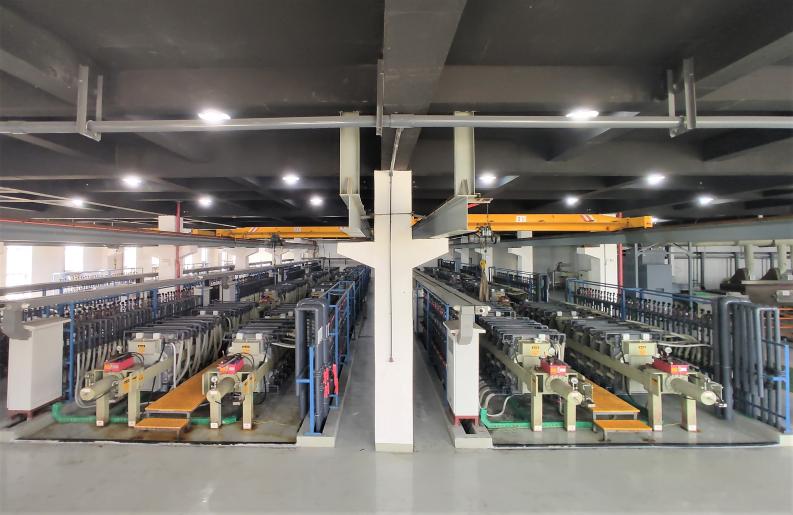
Electrodialysis (ED) for a 5t/h alkali separation and reuse project at a viscose fiber enterprise, showing the treatment scale and operating indicators of this technical route in similar projects.
Key indicators
- Treatment capacity: 5t/h
- Membrane area: 2178m2
Project background
Viscose fiber production generates large volumes of alkaline waste liquid with a relatively high sodium hydroxide concentration and organic substances such as hemicellulose.
Direct discharge of the alkaline liquid not only wastes resources but also significantly increases the chemical costs of subsequent neutralization and wastewater treatment.
The project objective is to separate reusable alkali from organic impurities so that the alkaline liquid can be returned to the production process for recycling.
Process route
- With electrodialysis (ED) as the core, sodium ions and hydroxide ions enter the recovery side under a direct-current electric field to form alkaline liquid.
- The selective permeability of ion-exchange membranes retains macromolecular organic substances such as hemicellulose on the feed liquid side.
- Appropriate pretreatment and cleaning procedures are set for high-viscosity feed liquid to maintain long-term flux of the membrane stack.
- The recovered alkaline liquid is returned for use according to process proportions, and the residual feed liquid enters the subsequent treatment process.
Configuration scale
- Treatment capacity: 5 t/h.
- Membrane area: 2178 m².
Illustrative materials