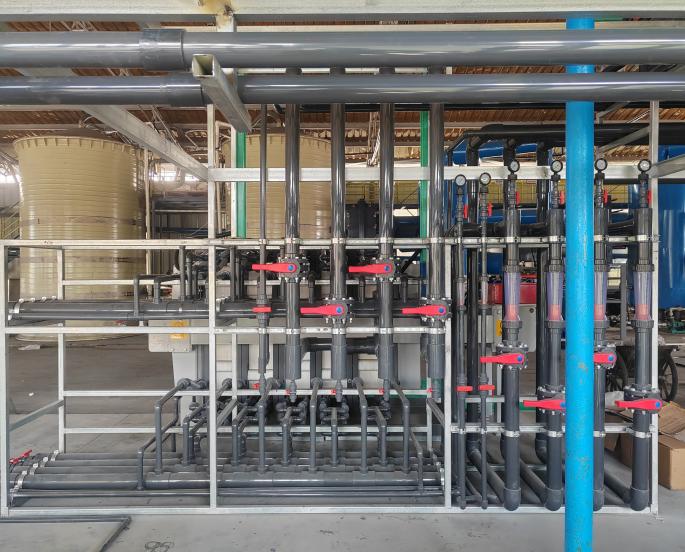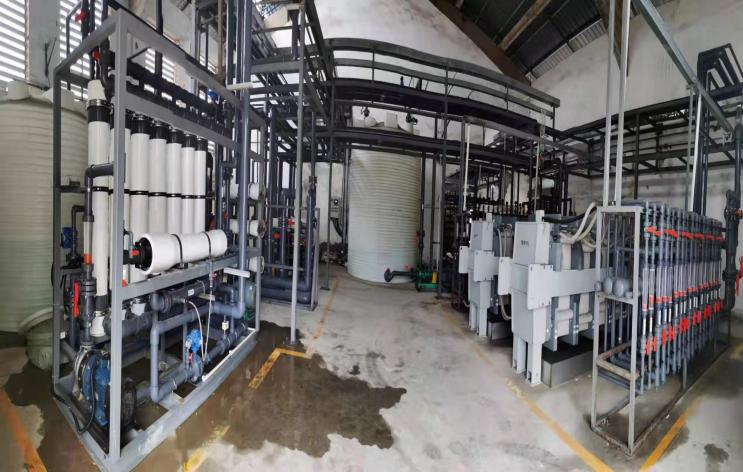
Bipolar membrane electrodialysis (BMED) for a 2m³/h sodium nitrate wastewater treatment project at a formed foil company, showing the treatment scale and operating indicators of this technical route in similar projects.
Key indicators
- Treatment capacity: 2m³/h
Project background
The formation foil production process uses a nitric acid system, and the cleaning and pickling steps generate wastewater containing sodium nitrate.
Direct discharge of nitrate wastewater not only causes loss of nitrogen resources but also increases the burden on downstream denitrification.
The project aims to recover acid and alkali while treating the wastewater, reducing discharge volume and chemical consumption.
Process route
- The sodium nitrate wastewater is treated by bipolar membrane electrodialysis (BMED), with the membrane stack consisting of bipolar membranes and homogeneous membranes.
- Hydrogen ions generated by water dissociation in the bipolar membrane combine with nitrate ions to form nitric acid, while hydroxide ions combine with sodium ions to form sodium hydroxide.
- The produced acid and alkali can be returned to the pickling and neutralization steps of formation foil production, respectively.
- Electricity is used as the driving force, avoiding the chemical dosing and by-product salt generation of conventional processes.
Configuration scale
- Treatment capacity: 2 m³/h.
Illustrative materials