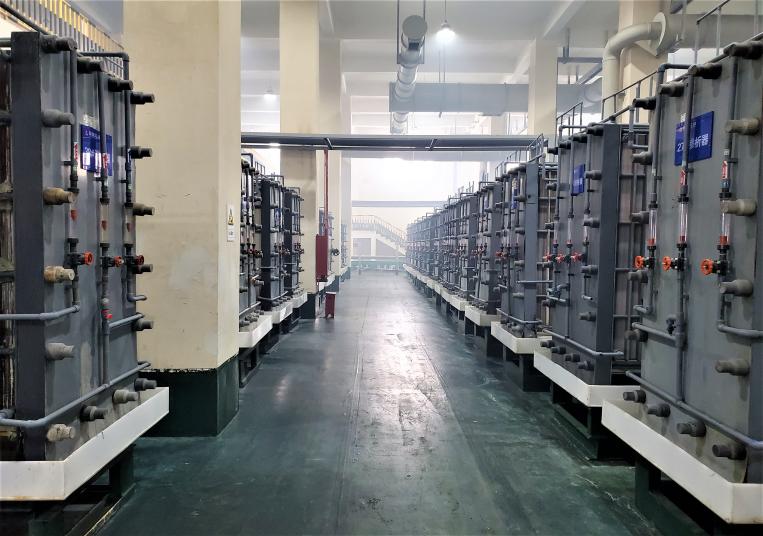
Diffusion dialysis (DD) is used in a 480 m³/day waste acid recovery treatment project for a titanium dioxide enterprise to show the treatment scale and operating indicators of this technical route in similar projects.
Key indicators
- Feed acid: 24%, ferrous content 45000 ppm
- Product acid ≥22%, ferrous content 500 ppm
- Treatment capacity: 480 m³/day
- Equipment: 93 units TWDD-128-400A
Project background
In sulfate-process titanium dioxide production, the hydrolysis and washing stages generate large amounts of sulfuric acid-containing waste acid, which also contains metal salts such as ferrous sulfate.
The waste acid is generated in large quantities and at relatively high concentration; neutralization disposal costs are high, and both sulfuric acid and iron salts have separate recovery value.
The project is designed on the premise of large-scale continuous operation, with the goal of stably recovering sulfuric acid and reducing the treatment load on the subsequent neutralization stage.
Process route
- Diffusion dialysis (DD) is used, driven by concentration difference to separate free sulfuric acid from metal salts.
- TWDD-128-400A diffusion dialysis stacks are configured and grouped in parallel according to treatment scale to form a continuous treatment line.
- Filtration and constant-temperature units are installed at the feed to reduce particulate fouling and maintain stable membrane flux.
- Recovered acid is returned to the acid hydrolysis or leaching process, and the salt-containing residual liquid enters subsequent treatment or by-product recovery.
Configuration scale
- Treatment capacity: 480 m³/day.
- Membrane stack equipment: 93 units (model TWDD-128-400A).
Illustrative materials