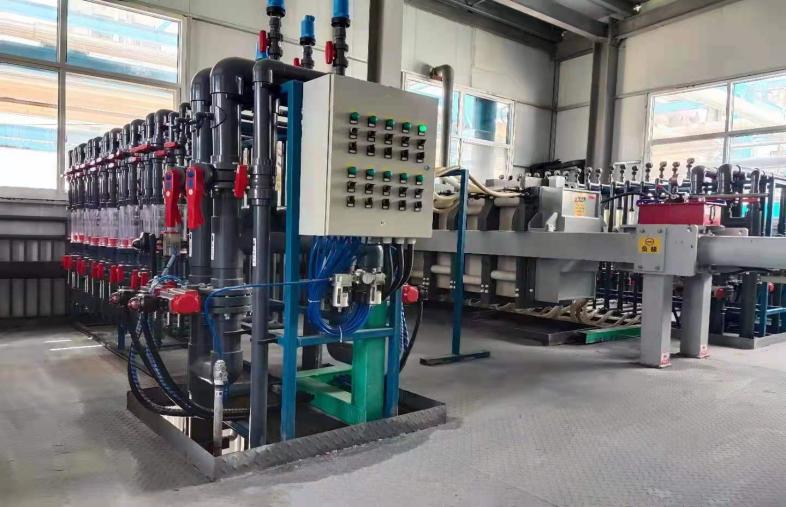
Electrodialysis (ED) used in a 3356m3/d wastewater treatment project for an electroplating enterprise, showing the treatment scale and operating indicators of this technical route in similar projects.
Key indicators
- Treatment capacity: 3356m3/d
- Membrane area: 34848m2
Project background
Electroplating wastewater has high salinity and a large volume and contains heavy metal ions and complexes, making it a typical difficult-to-treat industrial wastewater.
The industrial park requires increasing the water reuse rate while controlling the volume of discharged concentrate and the amount of hazardous waste generated.
The project uses electrodialysis (ED) as the core unit for desalination and concentration, creating conditions for subsequent reuse and reduction processes.
Process route
- Conventional electrodialysis (ED) is the main process, with a large number of membrane stacks configured in parallel according to the treatment capacity.
- Under the electric field, salts migrate to the concentrate compartment, and the product water from the diluate compartment is returned to production or the circulating system as reuse water.
- The pretreatment stage controls hardness, heavy metals, and organic matter to reduce the risk of membrane fouling and scaling.
- The concentrate enters subsequent evaporation or advanced treatment units, forming a closed process loop of reuse and reduction.
Configuration scale
- Treatment capacity: 3356 m³/d.
- Membrane area: 34848 m².
Illustrative materials