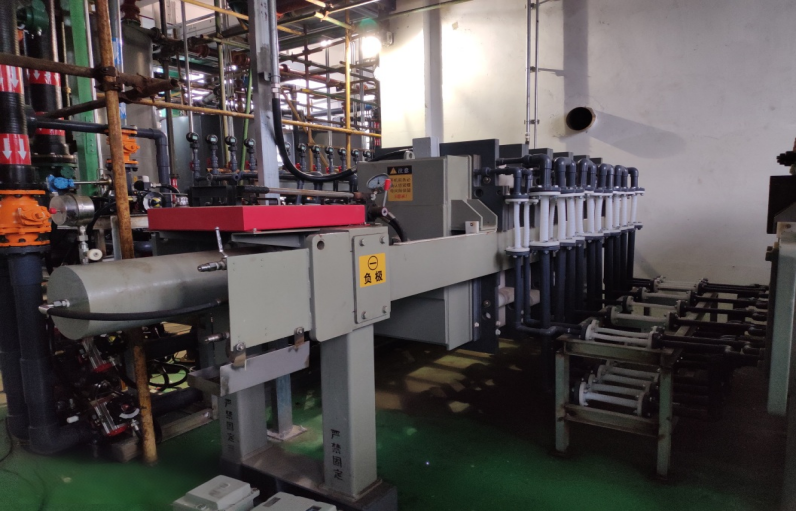
Bipolar membrane electrodialysis (BMED) used in a 480m3/d organic acid recovery project for a chemical enterprise, showing the treatment scale and operating indicators of this technical route in similar projects.
Key indicators
- Treatment capacity: 480m3/d
- Number of units: 8
- Total homogeneous membrane area: 4646m2
- Bipolar membrane area: 1307m2
Project background
Organic acid salt solutions are commonly generated in chemical production. Conventional acidification processes require the addition of inorganic acid and produce large amounts of inorganic by-product salts.
By-product salts have low value and are difficult to dispose of, while the introduced inorganic ions increase the burden of downstream separation.
The project aims to convert organic acid salts back into organic acids and alkali in a cleaner way, enabling internal circulation.
Process route
- Bipolar membrane electrodialysis (BMED) is adopted, with the membrane stack assembled by alternating bipolar membranes and homogeneous anion- and cation-exchange membranes.
- Hydrogen ions generated by water dissociation in the intermediate layer of the bipolar membrane combine with organic acid anions in the feed to form organic acids.
- Hydroxide ions combine with cations in the feed to form an alkali solution, which is returned to upstream processes for use.
- The entire process is driven by electricity, with no external inorganic acid added, and the amount of by-product salt is significantly reduced.
Configuration scale
- Treatment capacity: 480 m³/d.
- Equipment configured: 8 units.
- Homogeneous membrane area: 4646 m².
- Bipolar membrane area: 1307 m².
Illustrative materials