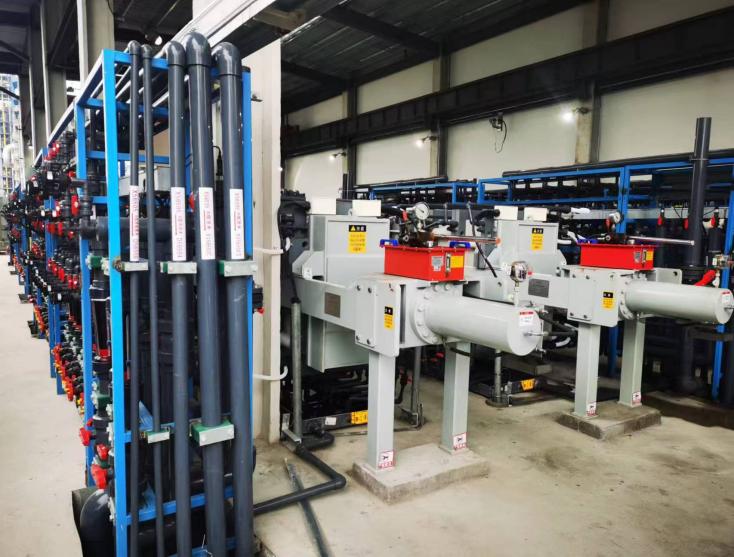
Bipolar membrane electrodialysis (BMED) for an 80m3/d lithium hydroxide recovery project at a battery company, showing the treatment scale and operating indicators of this technical route in similar projects.
Key indicators
- Treatment capacity: 80m3/d
- Total homogeneous membrane area: 968m2
- Bipolar membrane area: 484m2
Project background
The production process for lithium battery materials generates lithium salt-containing solutions and wastewater, and as a high-value element, lithium provides a strong incentive for recovery.
The traditional causticization method for preparing lithium hydroxide requires the addition of alkali agents and generates by-products, resulting in a relatively long process flow.
The project aims to use an electrically driven method to convert lithium salt directly into lithium hydroxide while producing acid that can be reused.
Process route
- Bipolar membrane electrodialysis (BMED) is adopted, with bipolar membranes and homogeneous membranes alternately assembled to form the membrane stack.
- Hydroxide ions generated by water dissociation in the bipolar membrane combine with lithium ions to form a lithium hydroxide solution.
- Anions in the feed liquid combine with hydrogen ions to form the corresponding acid, which can be returned to the upstream process for use.
- Electricity is used as the driving force instead of chemical agent addition, simultaneously reducing by-product salt and chemical consumption.
Configuration scale
- Treatment capacity: 80 m³/d.
- Homogeneous membrane area: 968 m².
- Bipolar membrane area: 484 m².
Illustrative materials