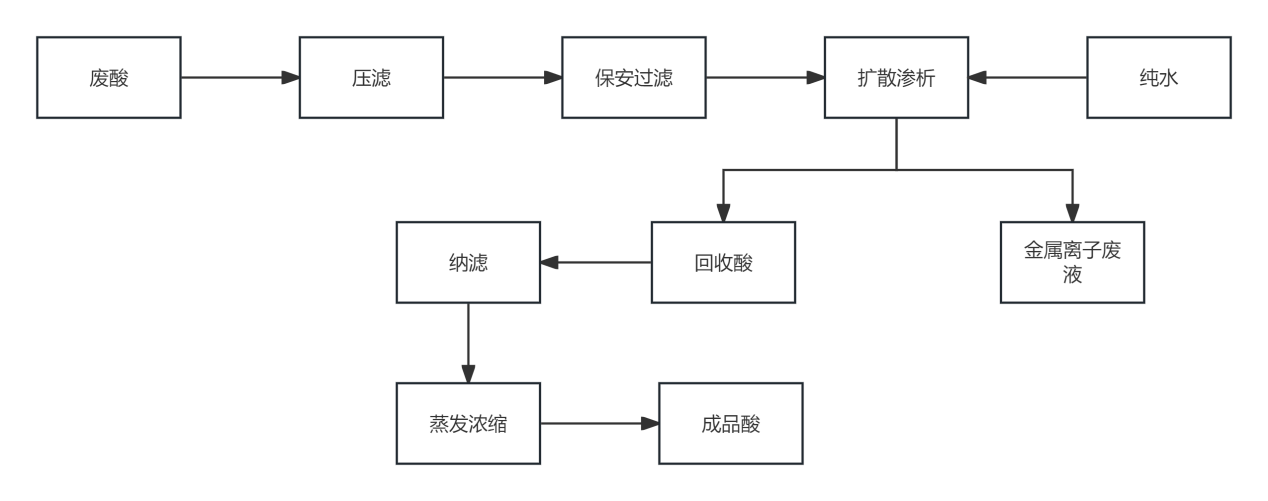
For metal-containing waste acid from titanium dioxide production, suspended solids are controlled first, then diffusion dialysis (DD) is used to selectively recover free acid. The recovered acid is purified and concentrated before returning to production, while the metal-containing by-product liquid is collected separately and evaluated for resource recovery routes.
Customer Goals
- Recover free sulfuric acid from waste acid and return it to the production process, reducing new acid procurement and the load on neutralization treatment.
- Separate the iron-containing and metal-containing by-product liquid to create conditions for subsequent resource recovery such as ferrous sulfate.
Recommended Process Route
-
Filter press impurity removal
The waste acid first passes through filter pressing to remove particulates and settleable impurities.
-
Security filtration
Further control suspended solids to reduce the risk of membrane module blockage and flow channel fouling.
-
Acid recovery by diffusion dialysis (DD)
Use pure water as the receiving liquid and achieve separation of free acid and metal salts through selective permeation.
-
Segregated collection
Recovered acid and metal ion by-product liquid are collected separately to avoid remixing.
-
Purification and concentration
Recovered acid is processed by nanofiltration and evaporation concentration to produce reusable finished acid. The specific configuration is determined by the target purity.
Outputs and Value
Finished acid
Returned to acid-consuming processes in titanium dioxide production. Actual concentration and impurity limits are confirmed by the production side.
Metal-containing by-product liquid
Based on the composition of iron and other metals, evaluate ferrous sulfate or other resource recovery routes.
Volume reduction benefits
Reduce fresh acid consumption, alkali neutralization chemical consumption, and neutralization sludge generation.
Engineering Inputs to Confirm
- Waste acid flow rate, operating schedule, and composition of free acid and metal ions.
- Levels of impurities that may affect the membrane system, such as suspended solids, colloids, and oils.
- Target concentration and purity of recovered acid, and quality requirements for return to the production process.
- Temperature, material compatibility, and validation conditions for the nanofiltration and evaporation sections.
The final process, equipment specifications, and operating indicators must be confirmed based on the water quality report and bench-scale or pilot-scale testing results.
Process Flow Diagram